The 3 AI Loops We Actually Use

Quick Summary
- Market Pulse Loop captures verified signals weekly, scores them by relevance, and delivers a human-approved brief to stakeholders who need current competitive context
- Evergreen Content Loop transforms reusable insights into documented articles that compound in value, with each piece tied to measurable outcomes and a published schedule
- AI Visibility Loop measures how well your content answers real audience questions, tracks citation patterns, and identifies coverage gaps across search and reference platforms
- Each loop requires approved data inputs, a measurable scoreboard, durable memory of past decisions, a defined schedule, and a human approval checkpoint before any action
Building reliable AI workflows means moving past one-off prompts and toward repeatable loops that deliver measurable value. Over the past two years, we have tested dozens of operational patterns with teams who use AI for research, content, and competitive intelligence. Three patterns have proven durable, scalable, and genuinely useful without requiring unrealistic assumptions about data access or automation. These three loops form the foundation of practical AI operations: Market Pulse, Evergreen Content, and AI Visibility. Each loop follows a consistent structure of approved inputs, scored outputs, memory, a schedule, and a human approval gate.
Download the Three AI Loop Files
Each complete Agent Edition package is available below as a permanent ZIP download. Every package includes its instructions, configuration examples, reference material, and starter scripts so you can inspect the full workflow before adapting it.
Understanding the Three Loops
A loop is not a prompt. A loop is a recurring process that produces a measurable output on a fixed schedule, uses stored knowledge from previous iterations, requires human review before action, and learns from what worked and what did not. Think of a loop as a workflow that runs monthly, weekly, or on demand, but never runs without human eyes seeing the result first.
The three loops we will cover here address three real needs: staying current on market signals without drowning in noise, building a library of durable content that compounds in value, and understanding how visible your expertise is to your actual audience. None of these loops require access to private data, magic integrations, or real-time feeds you do not already control.
Market Pulse Loop
Market Pulse is a weekly intelligence brief built from sources you already track. The loop takes verified input signals (company announcements, regulatory filings, research reports, and news), scores each signal for relevance to your audience, and delivers a brief that your team approves before sharing.
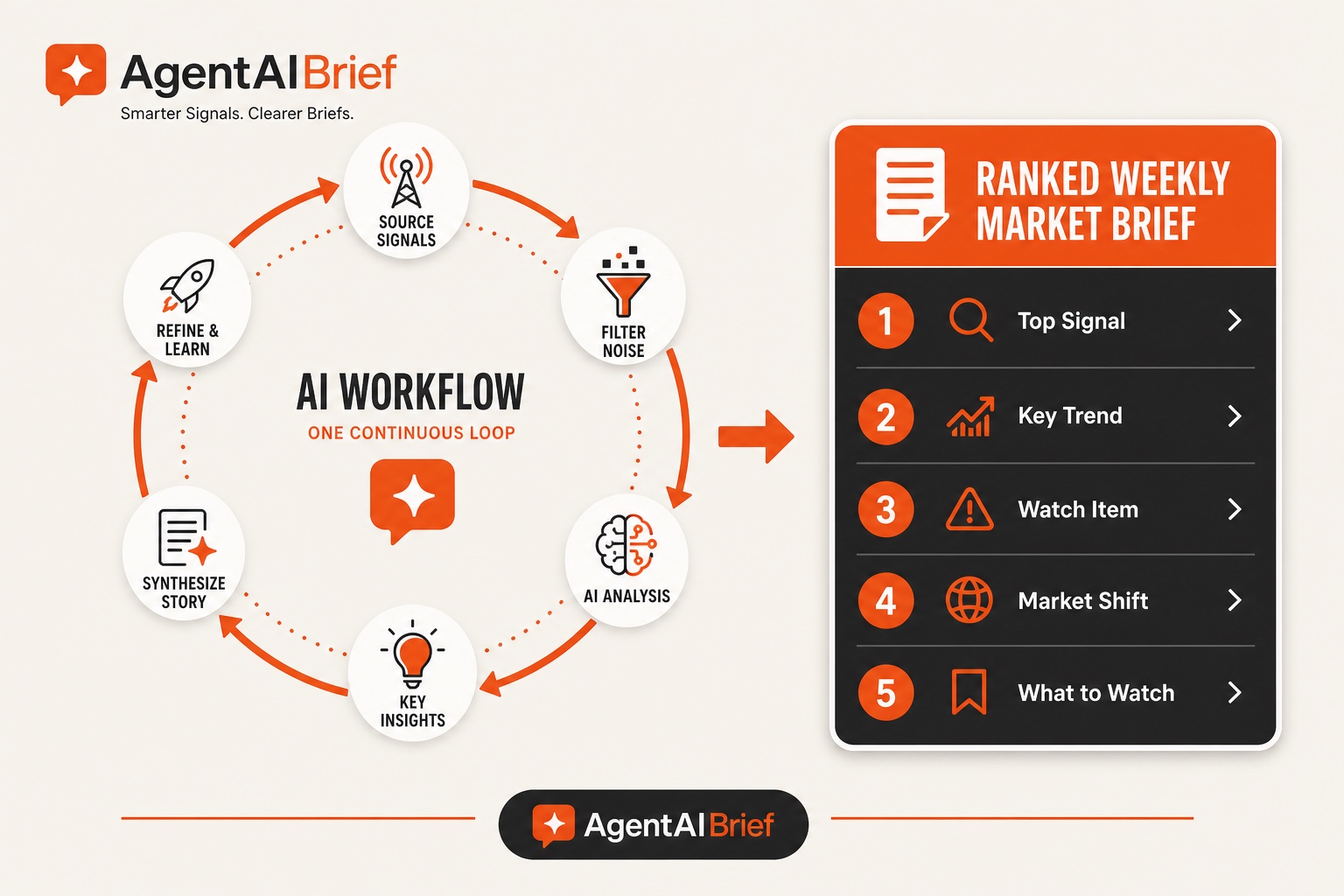
The inputs to Market Pulse must be sources you can justify: published research from named analysts, official company announcements, public regulatory filings, and news from recognized outlets. Tools that aggregate these sources (such as RSS feeds, API connections to news services, or curated research platforms) require the appropriate permissions and licensing. We do not claim automatic access to proprietary databases, email, or subscription content you do not own. You choose the sources, and the loop processes them.
The scoreboard for Market Pulse measures relevance, timeliness, and audience impact. Each signal is rated on whether it affects your audience's decisions, how recent it is, and whether your audience can act on it. The score determines which signals appear in the brief. A signal scoring eight or higher appears at the top. Signals below five are archived but not shared.
The memory in Market Pulse is your previous briefs and their performance. Which topics drove the most engagement? Which signals proved most predictive of actual changes in your market? A durable archive of past briefs, scored by reception, lets you weight future signals more intelligently.
The schedule is weekly. Every Tuesday at 9 AM, the loop processes all signals received since the previous Tuesday, scores them, and generates a draft brief. Your team has 24 hours to approve, edit, or reject the brief before it goes out Wednesday afternoon. This schedule is consistent, predictable, and manageable for a small team.
The approval gate is human review. No brief is sent without someone reading it, verifying the signals are accurately represented, and confirming the tone and focus match your audience. The person who approves the brief takes ownership of its accuracy. This is not a step you skip.
Evergreen Content Loop
Evergreen Content is a publishing pipeline that turns useful insights into documented articles, creates a durable library of reference material, and compounds in value as the library grows. Unlike Market Pulse, which is news and current, Evergreen Content solves persistent problems and answers questions that do not expire.
The inputs are insights worth publishing. These come from research you have conducted, patterns you have noticed, customer questions you hear repeatedly, or analysis that helps your audience make better decisions. The rule is simple: an insight is worth publishing if it solves a problem or answers a question your audience will still have six months from now.
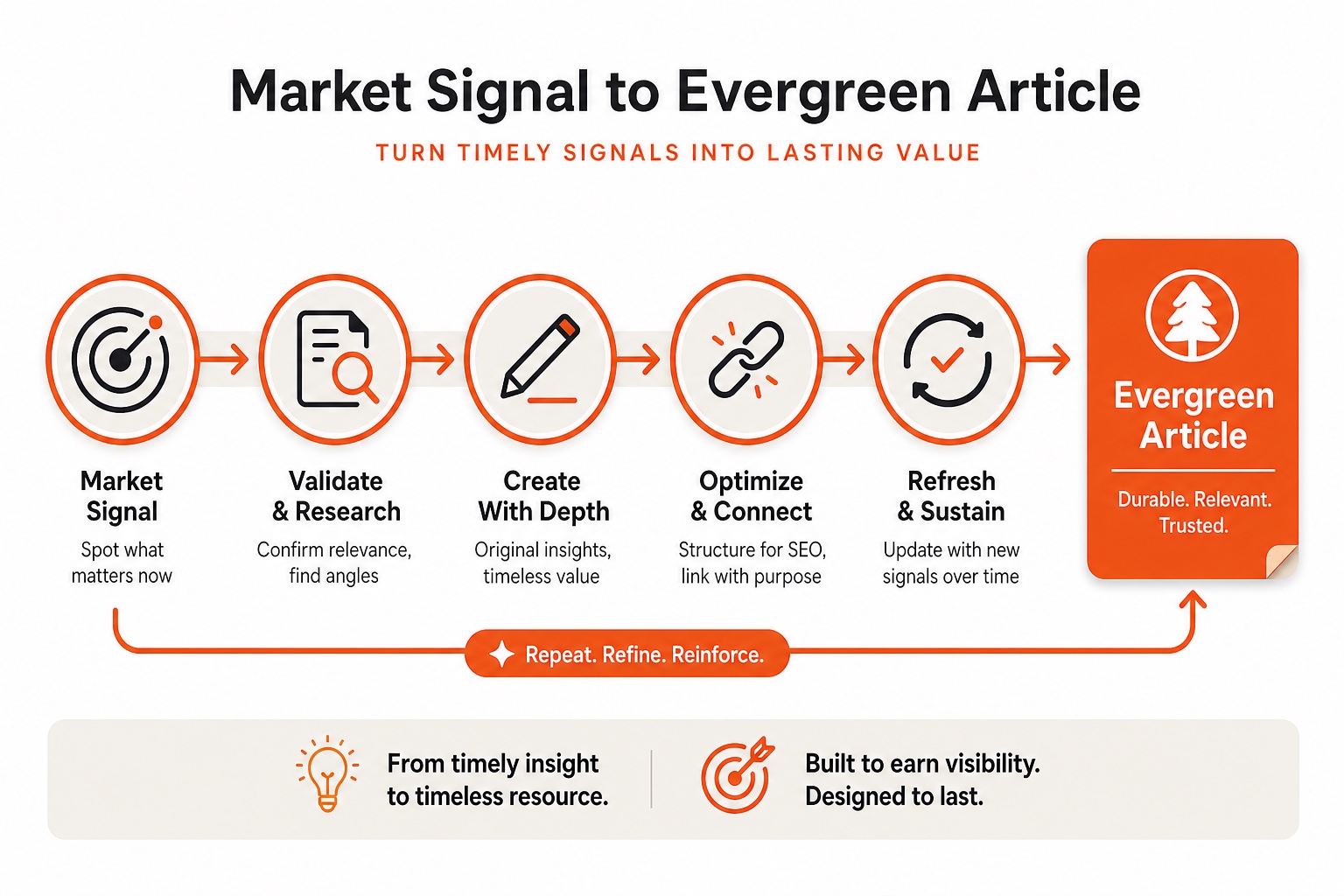
The scoreboard is a two-part measure. First, does the published piece get found? Track searches that land on the article, backlinks from other sites, and citations in other publications. Second, does it retain value? Measure engagement six months and twelve months after publication to confirm the article is still useful as a reference. Articles that score high on both measures become part of your core library and are updated and promoted regularly.
Memory in the Evergreen Content loop is your published library itself, plus metadata about each piece. What topics are covered well? Where are the gaps? Which pieces share audiences? Which pieces are outdated and need revision? A documented library, indexed by topic and audience need, lets you build deliberately instead of randomly.
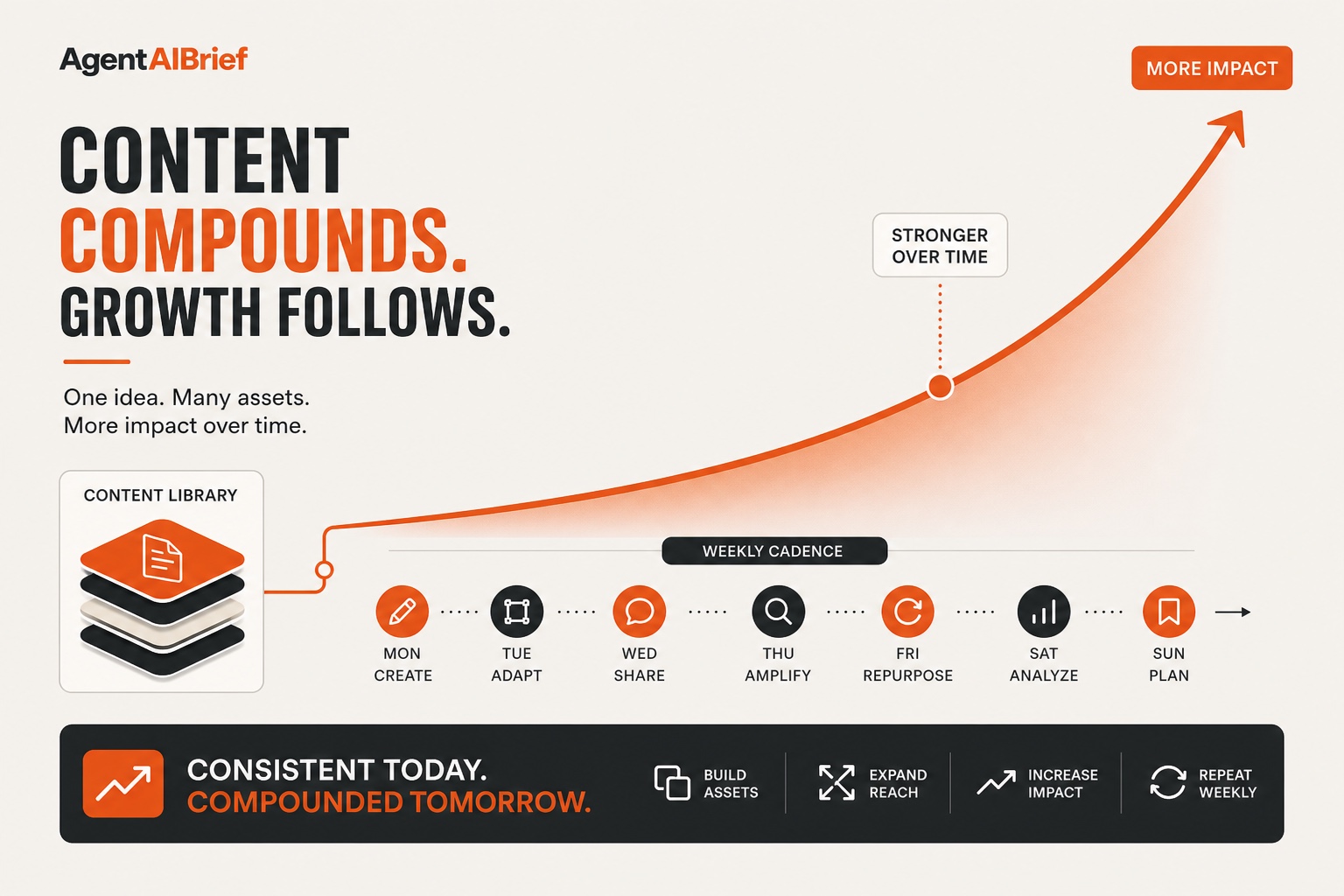
The schedule is consistent publishing. Commit to one to three pieces per week, depending on your team. Quality beats frequency, so three excellent pieces are better than ten rushed ones. Each piece is assigned to a writer or researcher, given a deadline, and moved through drafting and approval before publication.
The approval gate includes two checkpoints. A peer reviewer reads the draft for accuracy, clarity, and audience fit. Then an editor or subject matter expert approves the piece for publication. Only after both approvals does the piece go live. This process takes one to two weeks per article, which is why you plan a pipeline with work in different stages at once.
AI Visibility Loop
AI Visibility measures how often and how well your expertise appears when your audience searches for information related to your domain. The loop tracks where your content shows up, which sources get cited most often, and which questions your content does not yet answer well.
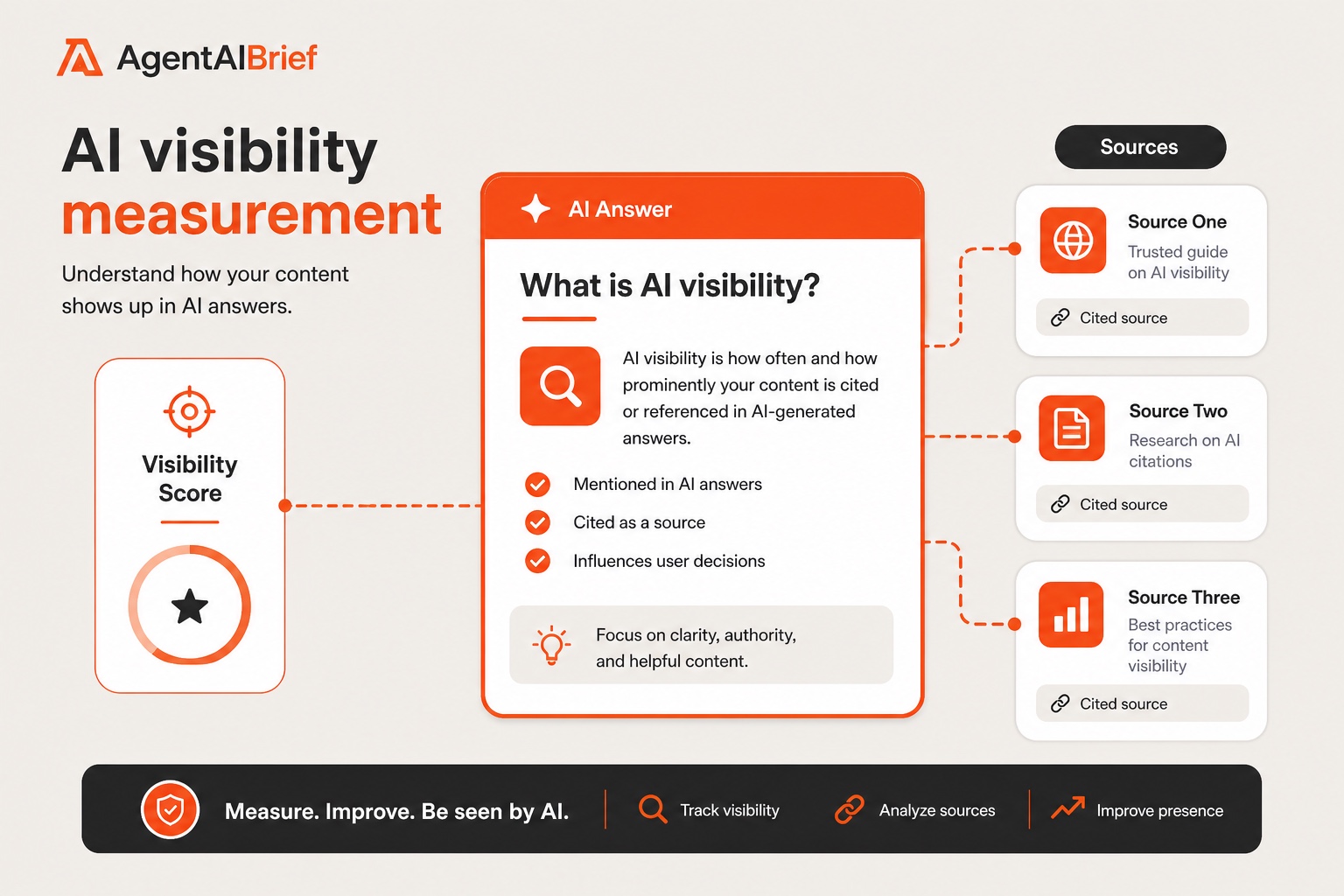
The inputs are search queries your audience uses and AI-powered search results. Tools like Google Search Console, SEO platforms, and AI search engines provide data on which queries surface your content and which do not. You must have legitimate access to these tools and the queries they measure. Tools that monitor AI search results (such as Perplexity, Claude, and OpenAI's search integrations) are increasingly available, but access is not automatic. Verify that your tools include proper permissions and that you are tracking real queries, not synthetic data.
The scoreboard tracks three metrics: answer rate, citation rate, and source diversity. Answer rate is the percentage of relevant searches where your content appears in the results. Citation rate is how often your content is directly cited or quoted. Source diversity is whether you rank well across different search platforms and AI reference tools, or only on one or two. A healthy score means you appear for 40 percent or more of relevant queries, are cited in 20 percent of results that mention your topic, and show up across at least three different major search interfaces.
The memory is a database of every search query tracked, every result your content appeared in, and every citation. Over time, this history shows which pieces are most visible, which are fading, and which new topics are emerging that you are not yet covering well. A documented query log becomes your roadmap for future Evergreen Content.
The schedule is monthly analysis. Every month, you pull a report of your visibility metrics, compare them to the previous month, identify the highest-impact gaps, and plan new Evergreen Content or updates to existing pieces to address those gaps. This creates a feedback loop between what your audience asks and what you publish.
The approval gate is a review of recommendations before action. When the analysis suggests you should update an article or write a new piece, someone who knows your audience and your constraints reviews that recommendation and approves, modifies, or rejects it. The analysis is not a command; it is input to a human decision.
Connecting Loops with Workspace Agents
OpenAI workspace agents can orchestrate these loops by connecting to approved tools, running on schedules, and managing files and memory. A workspace agent can be configured to run the Market Pulse workflow every Tuesday, the Evergreen Content workflow on your publishing schedule, and the AI Visibility analysis every month.
Workspace agents work with tools you give them permission to use. For Market Pulse, an agent might connect to RSS feed readers, news aggregation APIs, or research databases you subscribe to. For Evergreen Content, an agent might draft articles, store them in shared files, and coordinate approvals. For AI Visibility, an agent might pull data from SEO tools and search platforms you authorize.
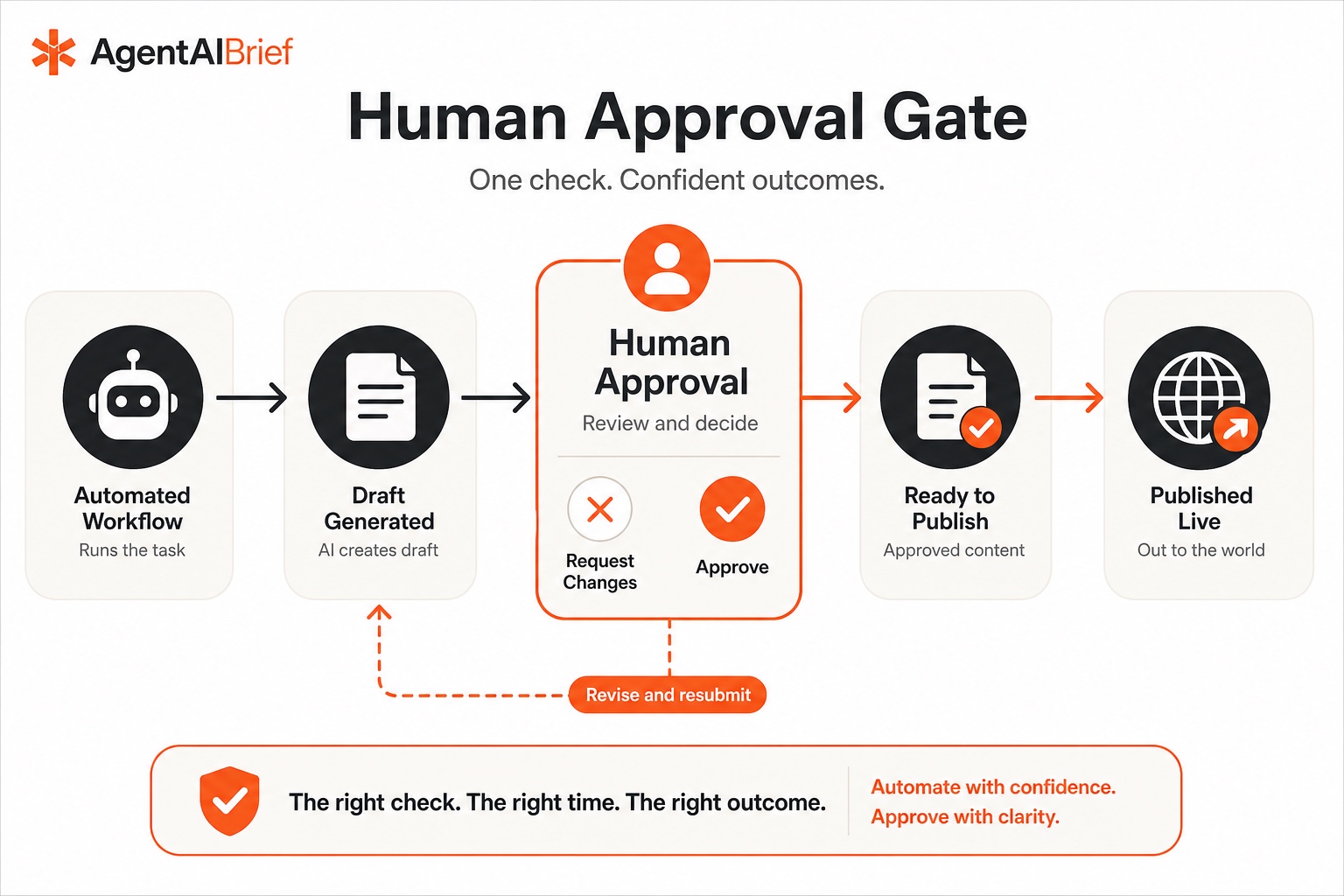
The key constraints are these: tools require explicit permissions and licensing. No agent can access private email, proprietary CRM data, or subscription content you do not own. Write permissions should be limited. An agent can draft an article and store it for human review, but it should not publish directly. Approvals should be explicit human actions, not implicit workflows. For detailed information on how workspace agents work and how to configure them safely, see the official workspace agents documentation and the API reference for agents.
Implementation Checklist
Before you run any of these loops, verify you have the inputs, scoreboard, memory structure, schedule, and approval process in place. Use this checklist to ensure each loop is set up correctly.
Market Pulse Setup:
- [ ] List the five to ten verified sources you will track (news, research, regulatory, company announcements)
- [ ] Confirm you have access to each source and any necessary permissions or subscriptions
- [ ] Define the scoring rubric: what makes a signal relevant, timely, and actionable?
- [ ] Create a template for the weekly brief that includes signal summary, score, and recommended action
- [ ] Assign a person to review and approve each brief before distribution
- [ ] Schedule the weekly review meeting (suggest Tuesday morning production, Wednesday afternoon distribution)
- [ ] Set up a file or database to store all previous briefs for reference
Evergreen Content Setup:
- [ ] Audit your existing content library. What topics are covered? What questions do you get repeatedly?
- [ ] Define your content calendar for the next three months with specific article topics and assigned authors
- [ ] Create a template and style guide so all articles maintain consistency
- [ ] Assign a peer reviewer and a final approver for each piece
- [ ] Set publication frequency (one, two, or three pieces per week)
- [ ] Create a metadata spreadsheet tracking each article's topic, keywords, publication date, and engagement metrics
- [ ] Plan how often you will review and update existing articles (quarterly is a good baseline)
AI Visibility Setup:
- [ ] List the search queries your audience uses most often (use Google Analytics, customer interviews, and search console data)
- [ ] Set up access to relevant monitoring tools (Google Search Console, an SEO platform, and ideally monitoring for AI search results)
- [ ] Create a spreadsheet to track answer rate, citation rate, and source diversity each month
- [ ] Define which gaps in visibility are most important to address first (focus on high-impact, high-frequency searches)
- [ ] Schedule monthly analysis (suggest the first Monday of each month)
- [ ] Connect visibility gaps back to Evergreen Content planning. Which new articles would close the biggest gaps?
Common Failure Modes
These loops fail in predictable ways. Watch for these patterns and correct them quickly.
Loop Runs Without Approval: The most common failure is a loop that produces output and distributes it without anyone checking. Market Pulse briefs go out with inaccurate signals. Articles are published with errors. Visibility reports recommend changes no one is prepared to make. Fix this by making approval explicit, assigning a person to it, and never automating the approval step itself.
Scoreboard Becomes Invisible: A loop that measures something but never looks at the measurement dies quickly. If you score Market Pulse signals but never review which scores were accurate, the scoring becomes noise. If you track Evergreen Content engagement but never use it to improve, the tracking becomes busywork. Review your scoreboard every month. Let the data shape your decisions.
Memory Degrades: As loops run, they accumulate old decisions, outdated analyses, and stale content. Without regular maintenance, the memory becomes a cluttered archive rather than a useful reference. Schedule quarterly reviews of your archives. Delete what is truly obsolete. Consolidate similar articles. Update metadata to reflect what you have learned.
Schedule Slips: The most durable loops are also the most boring. Market Pulse at the same time every week. Evergreen Content on a predictable schedule. AI Visibility on a fixed date. When the schedule starts to slip, the loop breaks. Build the schedule into your calendar like a recurring meeting. Make it as rigid as your team can manage.
Approval Gate Becomes Rubber Stamp: If the person approving the output always approves without reading, the approval becomes decoration. The purpose of the approval gate is to catch errors, ensure quality, and take responsibility for accuracy. If approvals are happening without genuine review, the gate has failed.
30-Day Rollout Timeline
You do not need to launch all three loops at once. A staged rollout reduces chaos and lets you learn from each loop before adding the next.
Week One: Prepare Market Pulse
- [ ] Identify and vet your five to ten information sources
- [ ] Build a scoring rubric and approval template
- [ ] Assign the approval responsibility to a person
- [ ] Create an archive file for briefs
Week Two: Run Market Pulse Once
- [ ] Collect signals from your sources
- [ ] Score each signal according to your rubric
- [ ] Generate a draft brief
- [ ] Get approval from your designated reviewer
- [ ] Send the brief to your stakeholder group
- [ ] Ask for feedback: was this useful? Accurate? Well-timed?
Week Three: Improve and Repeat
- [ ] Refine your scoring rubric based on feedback
- [ ] Publish a second brief with improvements
- [ ] If feedback is positive, commit to weekly Market Pulse
- [ ] Begin planning Evergreen Content meanwhile
Week Four: Prepare Evergreen Content
- [ ] Audit your existing published content
- [ ] List the twenty questions your audience asks most often
- [ ] Identify which of those are not yet well covered by your content
- [ ] Assign the first three article topics and authors
- [ ] Create your content template and style guide
By Day Thirty:
- Market Pulse is running weekly and generating consistent value
- First Evergreen Content articles are in draft or production
- You are collecting baseline data for AI Visibility
Month Two: Launch Evergreen Content
- [ ] Publish first batch of Evergreen Content articles
- [ ] Build your metadata and tracking method
- [ ] Begin monitoring engagement metrics
- [ ] Refine your publishing schedule
Month Three: Launch AI Visibility
- [ ] Set up search monitoring and visibility tools
- [ ] Run first month of AI Visibility analysis
- [ ] Identify top visibility gaps
- [ ] Connect gaps to Evergreen Content planning
By the end of ninety days, all three loops are running, each is producing measurable value, and your team understands how to maintain and improve them.
Frequently Asked Questions
Can I automate the approval gate?
No. The approval gate exists to catch errors, ensure quality, and create accountability. Automating approval defeats the purpose. The person who approves takes responsibility for accuracy. That is a human action.
What if I do not have the data sources for Market Pulse?
You already have them. You are reading news, research reports, and company announcements now. The loop just makes that reading consistent and documented. Start with the sources you already monitor. Add more later if you find valuable ones.
How many Evergreen Content articles do I need?
Start with three to five strong pieces covering your core topics. Quality beats quantity. A library of twenty well-researched, documented articles is more valuable than a library of a hundred rushed pieces. Grow deliberately over time.
Do I need special software to run these loops?
Not expensive software. Market Pulse can run in a spreadsheet and shared document. Evergreen Content can live in a shared folder and a publishing platform you already use. AI Visibility can be tracked in a spreadsheet and monitored through tools you likely already have (Google Search Console is free). You can start with tools you own. More specialized tools can come later if they add value.
What if my team is small?
Start with one loop. Market Pulse is the smallest. Once it is stable, add the others. One person can manage Market Pulse. Two people can manage Evergreen Content (a writer and an approver). One person can run AI Visibility analysis. Do not start all three at once unless you have at least three people dedicated to the work.
How often should I review these loops to make sure they are working?
Monthly. Set a regular monthly review meeting where you look at the outputs and metrics from all three loops. Ask: are we generating value? Is the scoreboard accurate? Is memory being used or is it accumulating junk? Are approvals meaningful? Is the schedule sustainable? Make one to three improvements per month.
Failure Modes and How to Recover
Even well-designed loops fail sometimes. Here is how to recover when they do.
Market Pulse Produces Noise
If your brief is full of signals that do not matter to your audience, the scoring rubric needs work. Sit with someone from your audience and ask which signals in the past few briefs actually mattered to them. Update your rubric to weight those signals higher. Run one additional week of analysis to test the new rubric, then adjust again if needed.
Evergreen Content Does Not Get Found
If your articles are published but not discoverable, you likely need better titles, keyword targeting, and internal linking. Pull a sample of your articles and ask: if I were searching for this topic, what would I search for? Make sure those terms are in your title and early in the article. Link from related articles. Submit your articles to relevant communities and platforms. Update your metadata.
AI Visibility Shows Declining Coverage
If your visibility is dropping while your publishing stays constant, your content may be getting outdated. Pull the articles that were visible two months ago but are not visible now. Refresh them with current information, new examples, and updated links. Re-index them in search engines.
Approval Gate Clogs
If approvals are backing up and delays are piling, either the approval process is too complicated or the approver is overloaded. Simplify the approval form. Make the approval task specific (read the piece for accuracy; check for brand consistency; verify facts). Consider rotating approval responsibility so one person is not the bottleneck.
Integration with Your Broader Team
These loops work best when they are connected to your broader operations. Market Pulse informs your sales team on what prospects care about. Evergreen Content drives inbound interest and establishes authority. AI Visibility shows you where to focus. The three loops feed each other.
Your sales team should see Market Pulse and use it to understand what your market is focused on. If a particular signal appears in three consecutive briefs, prospects are probably asking about it. That is a sign to create sales collateral or Evergreen Content about that topic.
Your product team should track Evergreen Content. If certain articles get high engagement, your audience needs solutions in that area. If visibility is low for a topic you thought was important, maybe your audience disagrees. Use the data to inform product decisions.
Your leadership should see the three scoreboards monthly. Not to micromanage, but to understand whether your content and intelligence operations are delivering value. If Market Pulse is not moving decision making, that is important to know. If Evergreen Content is not compounding, the strategy needs adjustment.
Sources and Additional Learning
For more information on workspace agents, see the official OpenAI documentation on workspace agents and how to configure them and the API reference for agents.
For Market Pulse workflows, look at published frameworks for competitive intelligence and weekly newsletters. The process we describe is not new; it is adapted from intelligence briefing practices that have worked for decades.
For Evergreen Content, document the source, editorial standard, review owner and update cadence before publishing. The principle is simple: consistent publishing on a documented schedule compounds over time.
For AI Visibility, use Google Search Console, standard SEO practices, and emerging tools that monitor AI search results. The measurement framework we describe is adapted from SEO analytics but applied to the newer problem of visibility in AI-powered search.
Next Steps
These three loops are not theoretical. They work because they are simple, repeatable, and measured. The barrier to starting is not technology. It is discipline. You need to commit to a schedule, define a scoreboard, and get human approval right before you launch.
The best time to start is when your team has capacity to run one loop well. That is usually Market Pulse. Get that running for two months until it is predictable and valuable. Then add Evergreen Content. Then AI Visibility. Do not start all three at once unless you have dedicated people for each one.
If you want to discuss how to adapt these loops to your specific situation, or if you want to see how workspace agents can help orchestrate them, we have resources and examples.
Ready to build a more reliable AI operation? Subscribe to AgentAIBrief to get weekly examples of practical loops, real implementation stories from teams who use them, and direct guidance on how to measure what actually matters.
These three loops scale from a small team to a large organization. They produce measurable value without requiring you to assume access to data you do not control or to automate decisions that need human judgment. Start with one loop. Build it right. Then add the next.