Ditching ChatGPT For Claude? Wait.
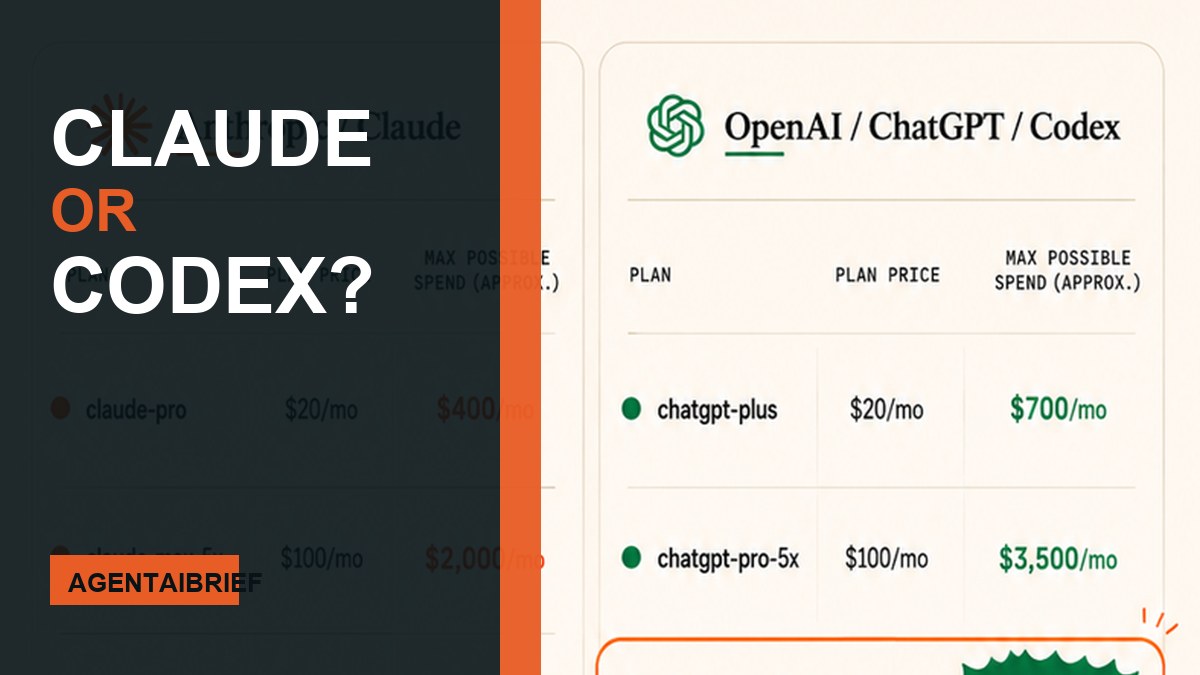
Player not loading? Watch this video directly on YouTube.
Quick Summary
- Claude is excellent for talking through ideas, writing, and reasoning.
- Codex is stronger when the job requires actual execution across files, browsers, commands, and repeatable workflows.
- The pricing comparison changes when an agent runs background tasks for hours instead of chatting for a few minutes.
- Real estate agents should not choose one AI tool for every job.
- The smarter move is to match the model to the work: Claude for thinking and drafting, Codex for doing and verifying.
The mistake is thinking this is a personality contest between AI tools. It is not. Claude can be brilliant for writing, strategy, and clean reasoning. ChatGPT can be useful for broad daily work. But when an agent needs a system that can sit at a computer, inspect a site, edit files, run checks, and keep going until the job is verified, the conversation changes.
That is why ditching ChatGPT for Claude without understanding Codex is the wrong lesson.
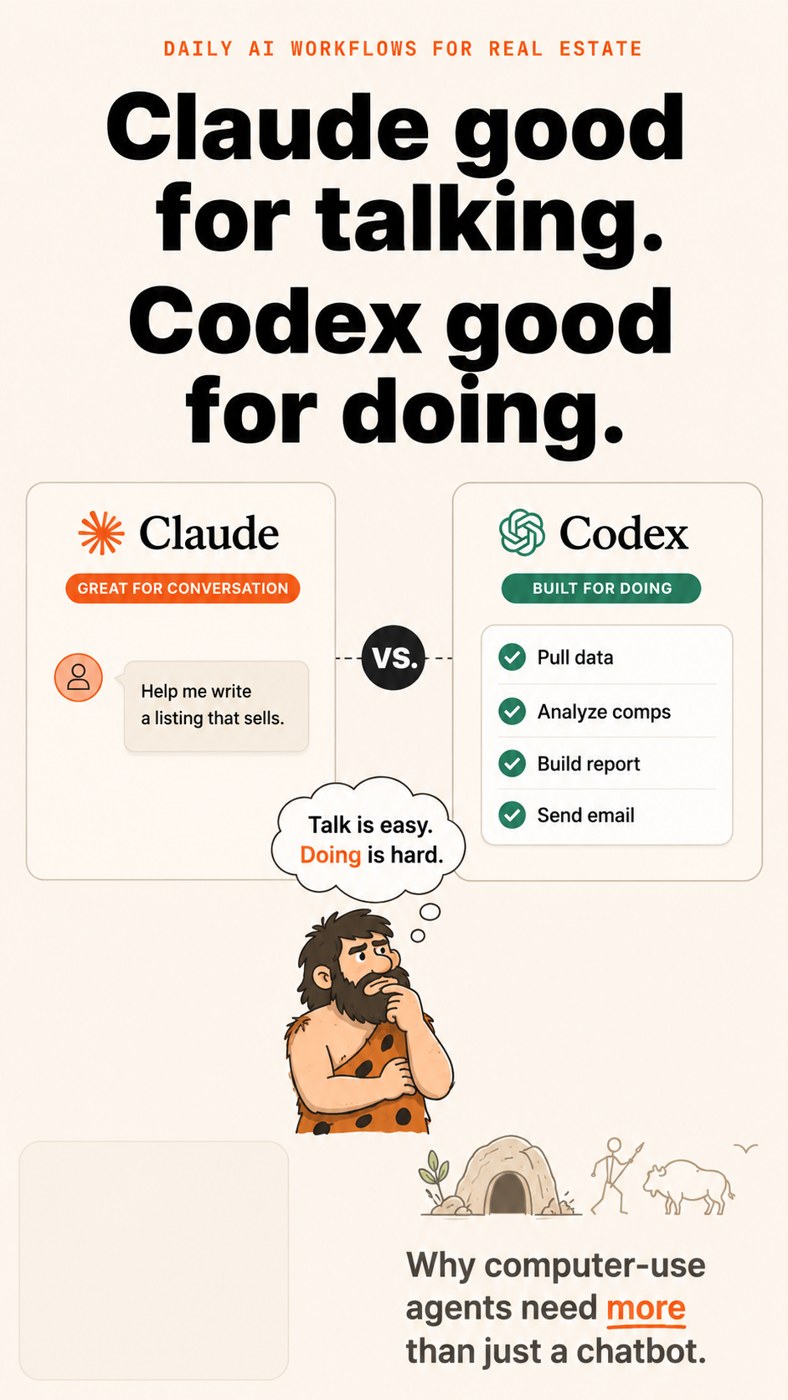
Claude may feel better in a chat window. Codex is built for a different job: turning messy instructions into actual work on a machine. For real estate agents, that distinction matters more than which chatbot sounds more polished.
Claude Is Great For Talking
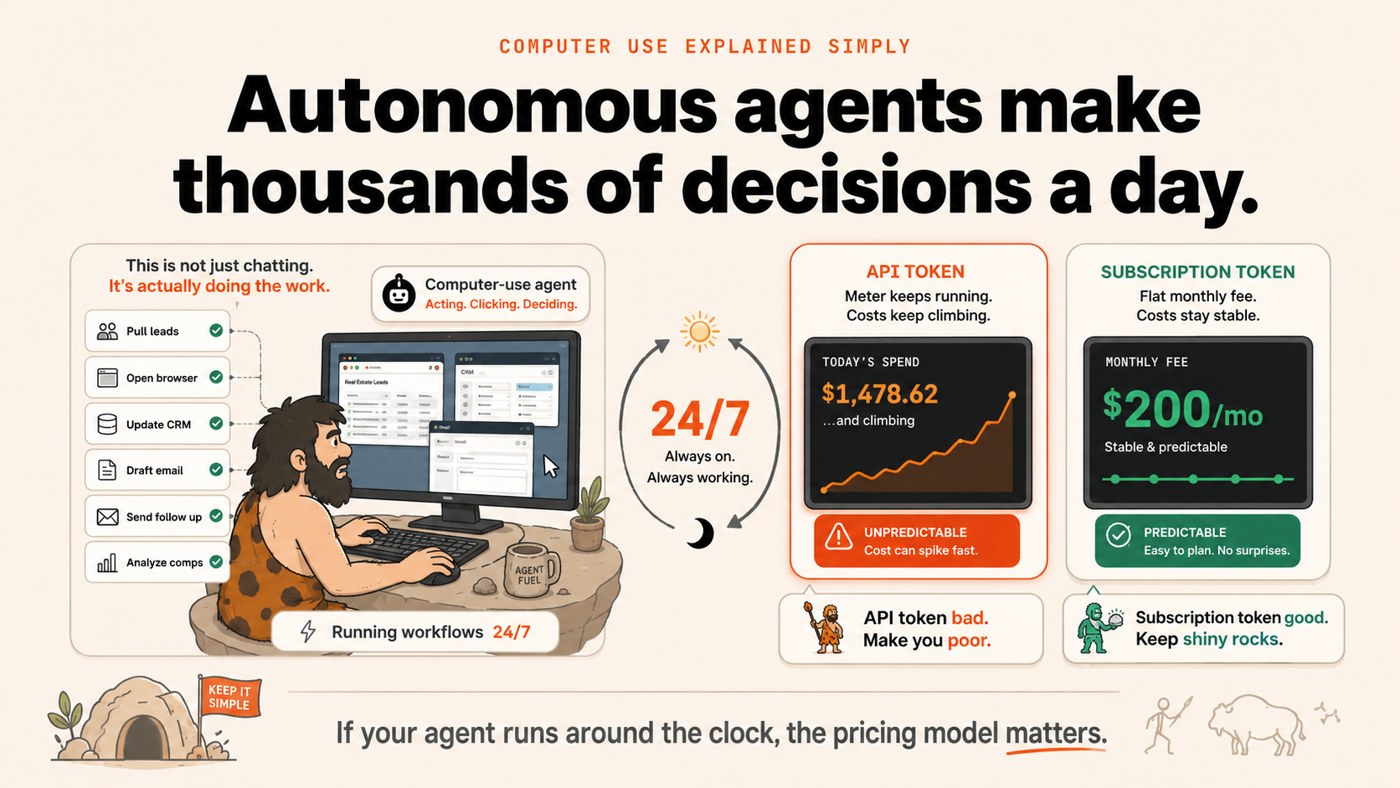
Claude is one of the best tools available when the job is thinking with you. It is strong at long-form writing, summarizing complex material, drafting thoughtful explanations, and helping shape an argument. If you are trying to turn a rough idea into a clean outline, Claude can be excellent.
That makes it valuable for agents. You can use it to draft a listing description, tighten an email, brainstorm a video angle, summarize a market report, or think through a client objection. It often gives answers that feel measured and readable. For a lot of daily work, that is enough.
The issue is that talking is not the same thing as doing.
If the task is "help me think through this blog angle," a chat model is fine. If the task is "publish the blog, upload the images, check the live page, create the tracking link, update the spreadsheet, and build the Instagram automation," a chat model by itself is not the operating layer. It can describe the steps. It does not automatically complete them.
That is where many AI comparisons get shallow. They compare the answer quality in a single prompt. Real business work is not one prompt. It is a chain of actions, checks, corrections, and proof.
Codex Is Built For Doing
Codex is different because it is designed around work in an environment. It can inspect a repository, edit files, run commands, use browser automation, verify output, and keep track of what changed. That makes it feel less like a writer and more like an operator.
For real estate agents, that difference is huge.
A real task might require pulling a Google Doc, extracting a script, creating a blog draft, generating or preparing images, publishing to a CMS, checking mobile layout, adding internal links, and confirming every image loads publicly. That is not just writing. That is production.
Production requires tools, state, and verification.
Codex can work inside that production loop. It can read files, patch code, run a build, open a page, inspect DOM output, compare screenshots, and report specific proof. When it fails, it can adjust the implementation and rerun the test. That is the part most agents miss when they only compare chatbot responses.
The future is not "Which AI writes the nicest paragraph?" The future is "Which AI can complete the repeatable business process with evidence?"
The Cost Story Changes With Agents
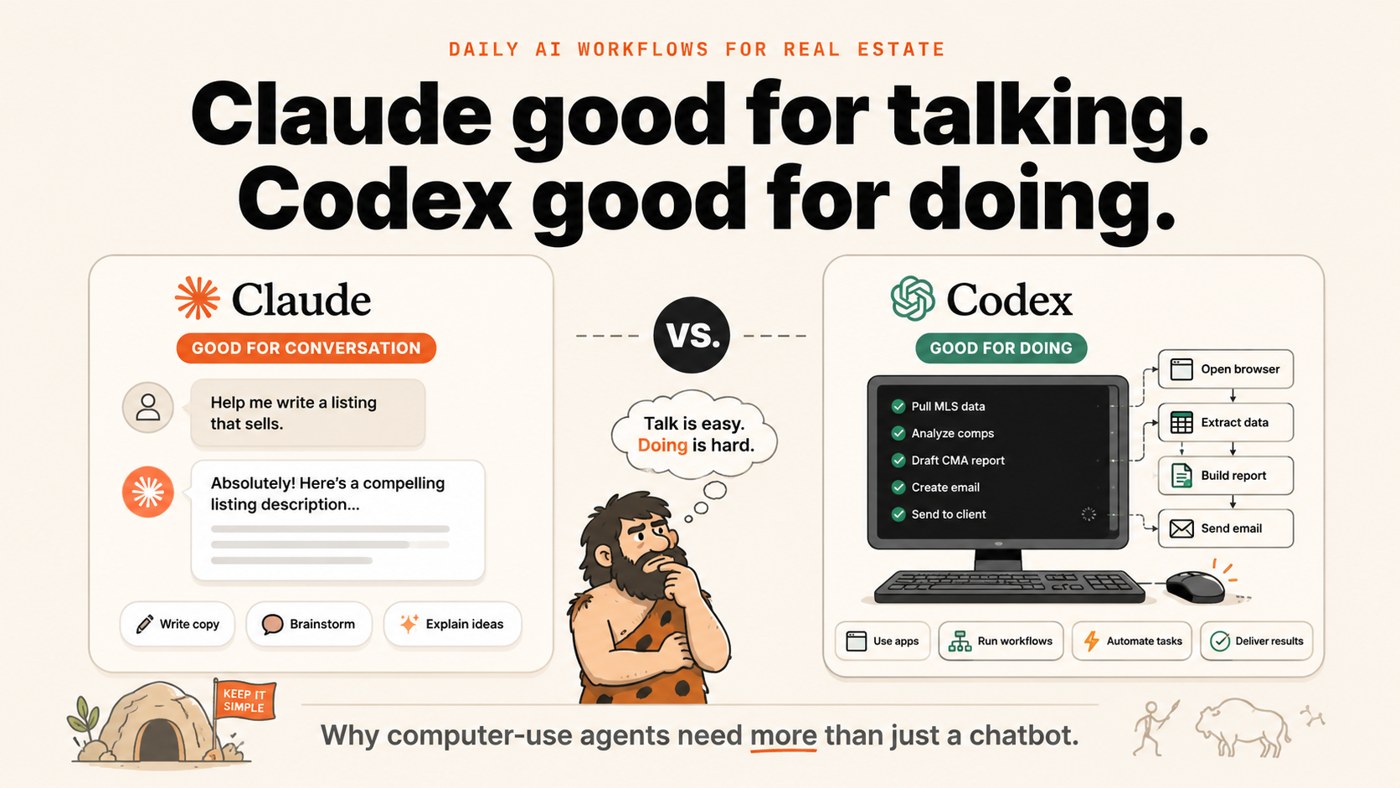
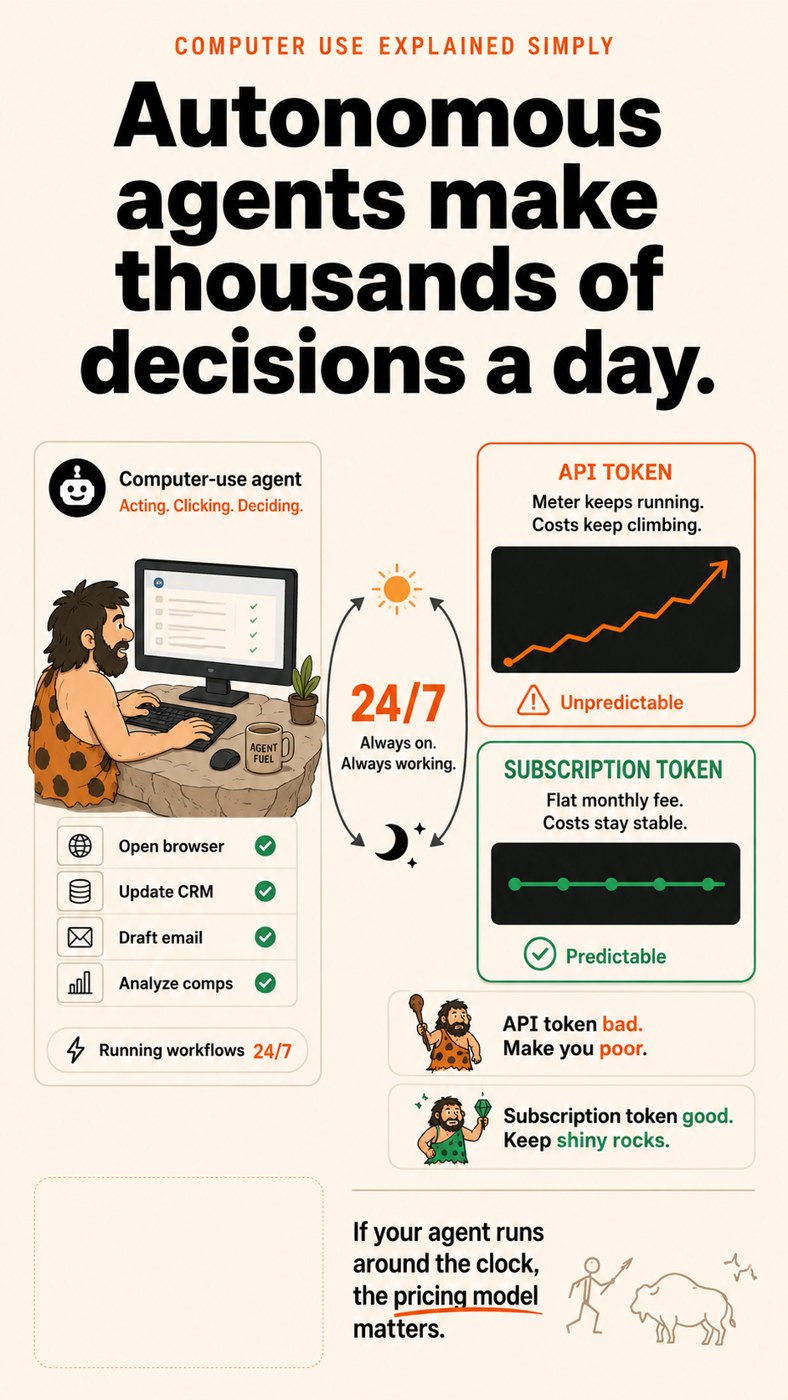
The subscription comparison looks simple until you think about autonomous work. A flat monthly chat subscription can feel generous when you are asking questions. But if an agent is running tasks around the clock, inspecting pages, using tools, and generating output for hours, the real cost is not only the subscription price.
The real cost is the work pattern.
If you ask an AI to draft a caption, the cost is small. If you ask an AI to manage a full content pipeline with research, publishing, QA, link creation, spreadsheet updates, and automation checks, that is a larger compute and tooling load. Some platforms handle that through subscriptions, some through usage, and some through a mix.
That means agents should stop asking, "Which one is cheaper?" in the abstract.
The better question is: cheaper for what?
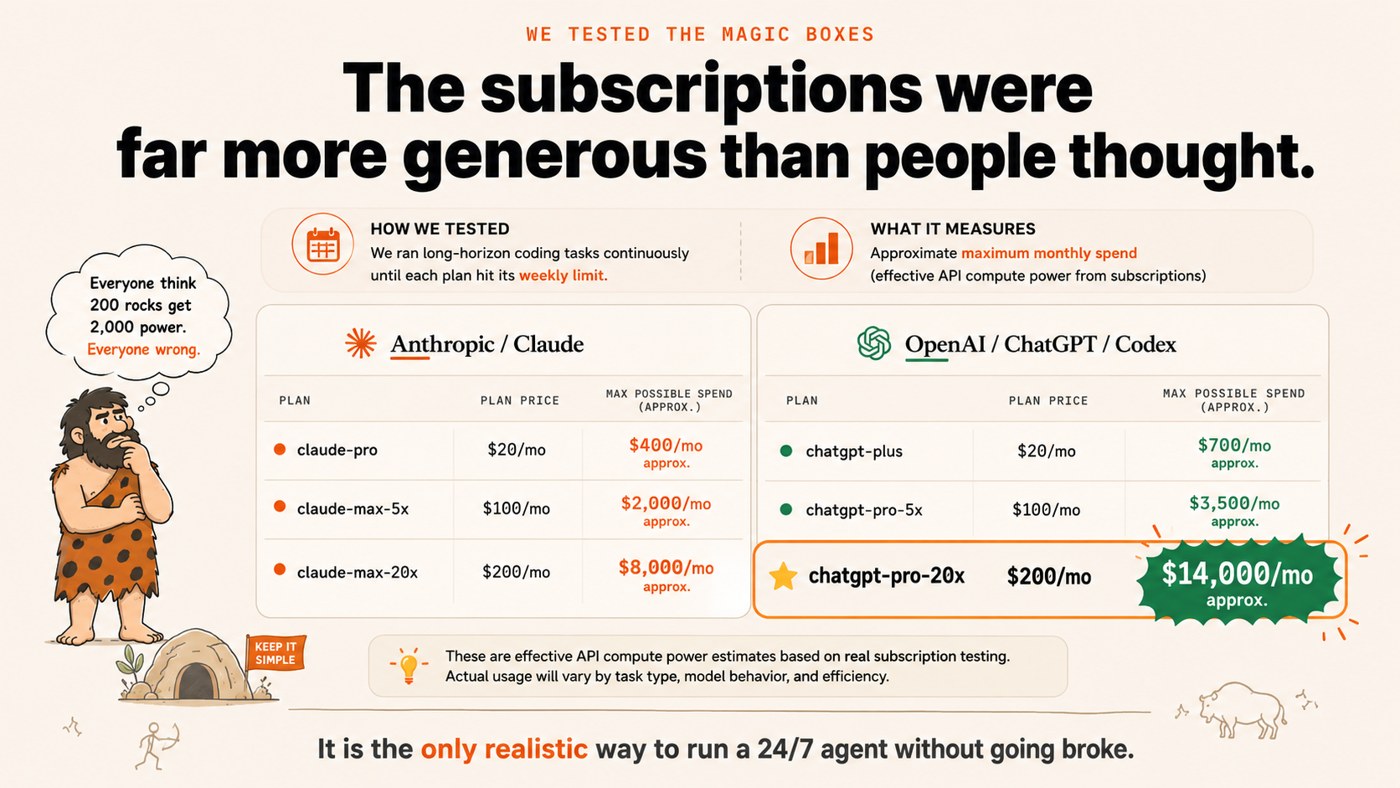
Claude may be a great value for writing and reasoning. Codex may be the better value when it saves hours of actual production time. A tool that costs more per unit can still be the better business decision if it completes work that would otherwise require a human assistant, a VA, or a developer.
For agents, time-to-completion is the number that matters. If the AI only gives advice, you still have to execute. If the AI executes and verifies, the value changes.
Real Estate Work Is Mostly Repetition
Real estate agents do not need AI because they lack ideas. They need AI because the same production tasks repeat constantly.
Listings need descriptions, ads, videos, landing pages, emails, print pieces, and follow-up. Local stories need research, scripts, blogs, social captions, images, links, and automations. SEO pages need updates, internal links, schema, fact checks, and mobile QA. Seller campaigns need proof, deadlines, and clean handoffs.
That kind of work is perfect for agentic systems because the pattern repeats but the inputs change.
A human should still set the standard. The human should decide the angle, approve sensitive public actions, protect compliance, and judge whether the output feels right. But the machine can do a lot of the assembly, checking, and repetition.
This is why Codex matters. It can turn a repeatable workflow into a process that actually runs. It is not just answering questions about the process. It is closer to doing the process.
What I Would Use Claude For
I would still use Claude. This is not an anti-Claude argument.
Claude is a strong choice for strategy memos, long explanations, nuanced rewriting, transcript cleanup, content angles, and decision support. If you want to talk through why a campaign is not converting, Claude can help you reason through the problem. If you want a polished first draft of a thoughtful article, Claude can be excellent.
I would also use Claude when tone matters and the work does not require a lot of external execution. It is often good at making text feel human without sounding sloppy. That is valuable.
But I would avoid pretending Claude is automatically the best answer for every AI task.
When the task has to touch files, browser sessions, local assets, live site verification, build systems, or a sequence of production steps, I would reach for Codex. Not because it "sounds" better. Because it is designed to work in the environment where the task lives.
Good operators do not pick tools by vibes. They pick tools by job.
What I Would Use Codex For
I would use Codex for repeatable business operations.
That includes publishing workflows, SEO refreshes, image QA, site edits, data cleanup, spreadsheet updates, local automation scripts, video packaging, page verification, and any task where the proof matters as much as the draft.
For example, an agent could build a system where Codex takes a local story from a spreadsheet, pulls the research doc, writes the blog, creates the image plan, inserts the images, checks mobile layout, creates the tracking URL, and prepares the social automation. That is not just AI writing. That is AI-assisted operations.
Another example is listing marketing. Codex can take approved listing facts and assets, create the page copy, generate social post variations, prepare a video structure, check filenames, and verify that the destination URL works. The agent still approves the public campaign, but the repetitive assembly gets faster.
That is the business case.
Codex is not magic. It still needs guardrails, clear instructions, and verification. But it can participate in the actual doing layer in a way that plain chat interfaces usually do not.
The Wrong Way To Compare AI Tools
The wrong way to compare AI tools is to paste the same prompt into three chat windows and pick the answer that sounds best.
That test has a place, but it is incomplete. It measures response style. It does not measure execution, reliability, tool access, browser handling, file edits, verification, memory, repeatability, or cost under real workload.
An agent choosing AI for business should compare jobs instead:
- Which tool writes the cleanest client-facing copy?
- Which tool can inspect a live page and prove the images load?
- Which tool can edit a site without breaking the build?
- Which tool can run the same workflow next week with new inputs?
- Which tool produces proof that a human can check quickly?
Those are better questions because they match the way work actually happens.
The chatbot that wins a writing prompt may not be the tool that wins the full workflow. The full workflow is where the leverage is.
The Agent Stack I Would Build
If I were advising a real estate agent, I would not say "use only Claude" or "use only ChatGPT" or "use only Codex."
I would build a stack.
Use Claude for thoughtful writing, reasoning, and careful drafts. Use ChatGPT for broad daily utility, image work, brainstorming, and quick exploration. Use Codex when the task becomes operational and needs files, browsers, builds, or verification. Use a human approval gate for anything public, legal, financial, or client-sensitive.
That stack is more realistic than tool tribalism.
The best agents will not win because they chose one chatbot. They will win because they build repeatable systems where the right model handles the right part of the job.
The model choice is not the strategy. The operating system is the strategy.
How This Looks In A Real Agent Day
Here is the practical version. An agent wakes up with three things on the board: a listing needs a video package, a local story needs to become content, and an old SEO page needs a refresh. Those are not the same AI job.
For the listing, the agent needs accurate property details, approved photos, compliant copy, a short video structure, caption variations, a landing page check, and maybe a YouTube or Meta ad prep packet. Codex is useful here because the work touches files, media, page destinations, and verification. The deliverable is not a nice paragraph. The deliverable is a package that can be inspected and used.
For the local story, Claude might help shape the angle. It can make the narrative clearer, find the emotional tension, and turn a messy research packet into a more readable draft. Then Codex can handle production: format the post, place images, check the live page, and make sure links work.
For the SEO refresh, ChatGPT or Claude can help think through the new intro and FAQ language. Codex can inspect the site files, update the page, run the build, and verify the output. The point is not to crown one model. The point is to stop forcing one tool to do every kind of work.
That is how AI becomes operational. Each model has a lane. Each lane has a quality gate. Each quality gate creates trust.
The Quality Gate Matters More Than The Model
Most agents are going to skip the quality gate, and that is where the damage happens.
The AI writes a post, but nobody checks whether the facts are current. The AI creates an image, but nobody checks whether it looks fake. The AI prepares a link, but nobody checks whether the link actually works. The AI drafts an automation, but nobody checks whether the public reply and direct message persisted after saving.
That is not an AI problem. That is an operations problem.
Codex is useful because it can be part of the quality gate. It can run checks, collect proof, compare output, and flag missing pieces. But even Codex needs instructions. A good workflow says what must be true before the task is complete. For a blog, that might mean word count, image loading, no repeated paragraphs, no trigger word in the public copy, and mobile layout checks. For an ad, that might mean destination URL, budget, dates, audience category, and approval status.
The model does not remove standards. The model makes standards easier to enforce if you write them down.
Why Agents Should Care Now
Agents should care now because the advantage is early and practical. A lot of people are still using AI like a search box with better manners. They ask for captions, emails, and listing descriptions. That is useful, but it is not the real leverage.
The real leverage is turning a repeating business process into a documented run. Once a process is documented, a tool like Codex can help run it again with new inputs. The second run is faster than the first. The third run is cleaner than the second. Eventually the agent is not starting from scratch each time.
That compounding effect matters in real estate because speed and consistency are both hard. Listings move fast. Local stories go stale. Seller leads need follow-up. SEO pages need maintenance. Social content needs packaging. The agent who can move from idea to verified asset faster has a real advantage.
This does not mean agents should let AI do everything. The best version is still human-led. The human chooses the angle, protects the brand, approves public actions, and decides whether the output feels right. AI handles the repetitive assembly and proof gathering. That division of labor is where the work gets faster without getting reckless.
The Simple Rule
Use Claude when you need a smart conversation.
Use ChatGPT when you need flexible general help, multimodal exploration, or fast creative ideation.
Use Codex when the job has to be executed in an environment and verified afterward.
That rule is not perfect, but it is better than arguing about which model is "best." Best depends on the work. A hammer is not better than a camera. A camera is not better than a spreadsheet. The question is what the job requires.
For agents, the job increasingly requires doing. That is why Codex belongs in the conversation.
Where This Is Going
AI is moving from answer engines to work engines.
The first wave was "ask a question and get an answer." The next wave is "give an objective and let the system do the work, check the work, and show proof." That shift is bigger than most agents realize.
In real estate, the opportunity is not only writing faster captions. It is building a production system that compounds. Every workflow that gets documented can become easier to repeat. Every quality gate that gets written down can be checked again. Every recurring task can be turned into a process.
That is the reason Codex deserves attention.
It is not just another chatbot. It is part of the move toward AI systems that can operate inside the same messy environments where the business already runs.
Claude is still useful. ChatGPT is still useful. But if you are trying to build a business that uses AI to actually get work done, do not stop the comparison at the chat window.
Frequently Asked Questions
- Should real estate agents switch from ChatGPT to Claude? Not blindly. Claude is excellent for writing and reasoning, but agents should choose tools by task, not by hype.
- What makes Codex different? Codex can work inside files, browsers, codebases, and verification loops, which makes it better suited for operational tasks than a normal chat-only workflow.
- Is Codex only for developers? No. Developers may understand it first, but the real business use is repeatable operations: publishing, QA, data cleanup, content production, and site workflows.
- Which AI tool should agents use first? Start with the tool that matches the job. Use a chat model for thinking and drafting. Use an operator-style system when the work needs execution and proof.
Want the deeper AI operating breakdown? Get free access to AgentAIBrief and follow @AgentAIBrief on Instagram for daily AI tips and workflows.