AI for Real Estate Agents: You Are Not Behind

Quick Summary
- AI for real estate agents is already useful, but dependable business-wide execution is much less common than social media makes it appear
- PNC's April 2026 consumer analysis found that the share of households in its data paying for a generative AI subscription had reached about 2% near the start of 2026
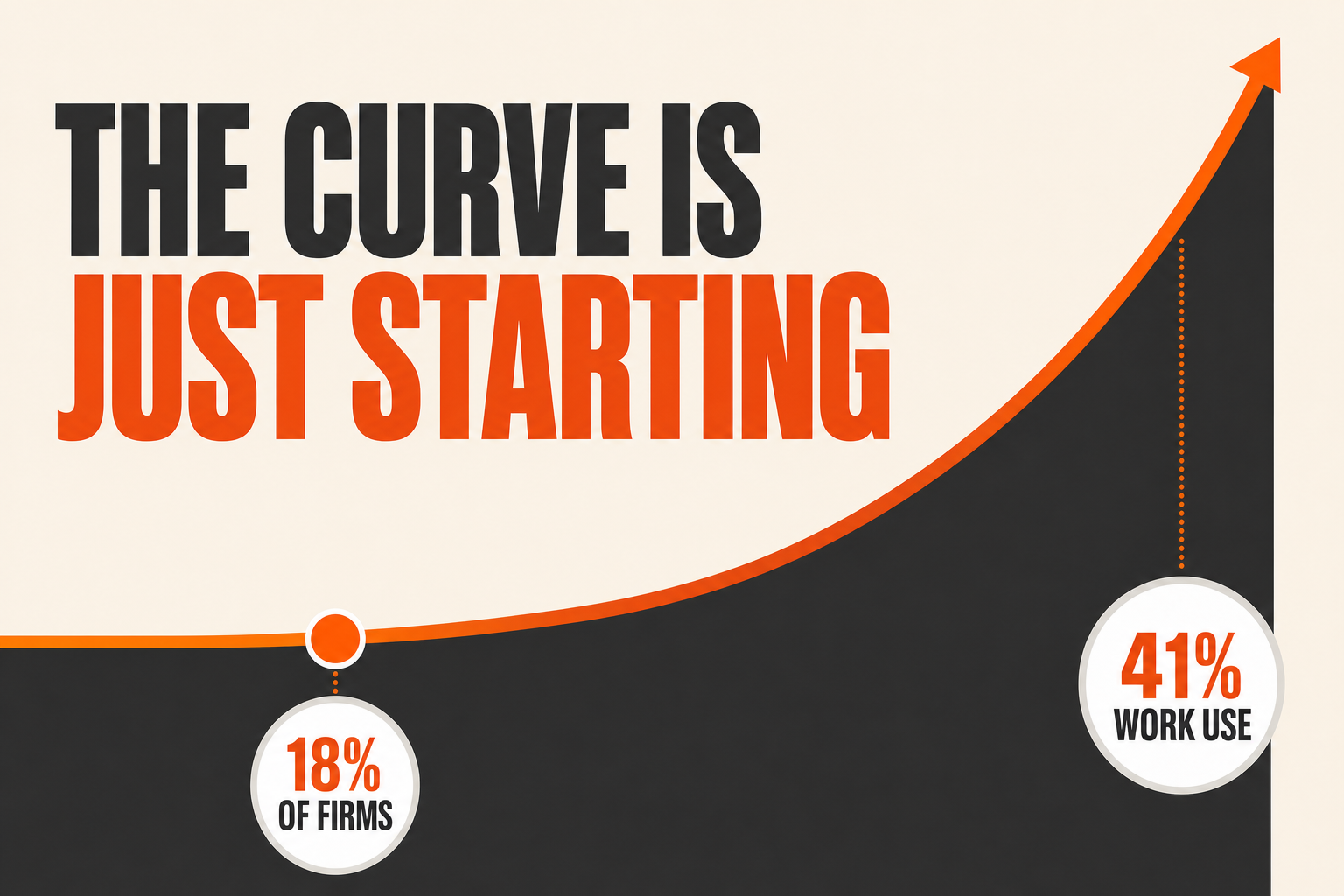
- Federal Reserve analysis found that about 18% of U.S. firms had adopted AI by the end of 2025, while work-related generative AI use reported by individuals reached about 41% in November 2025
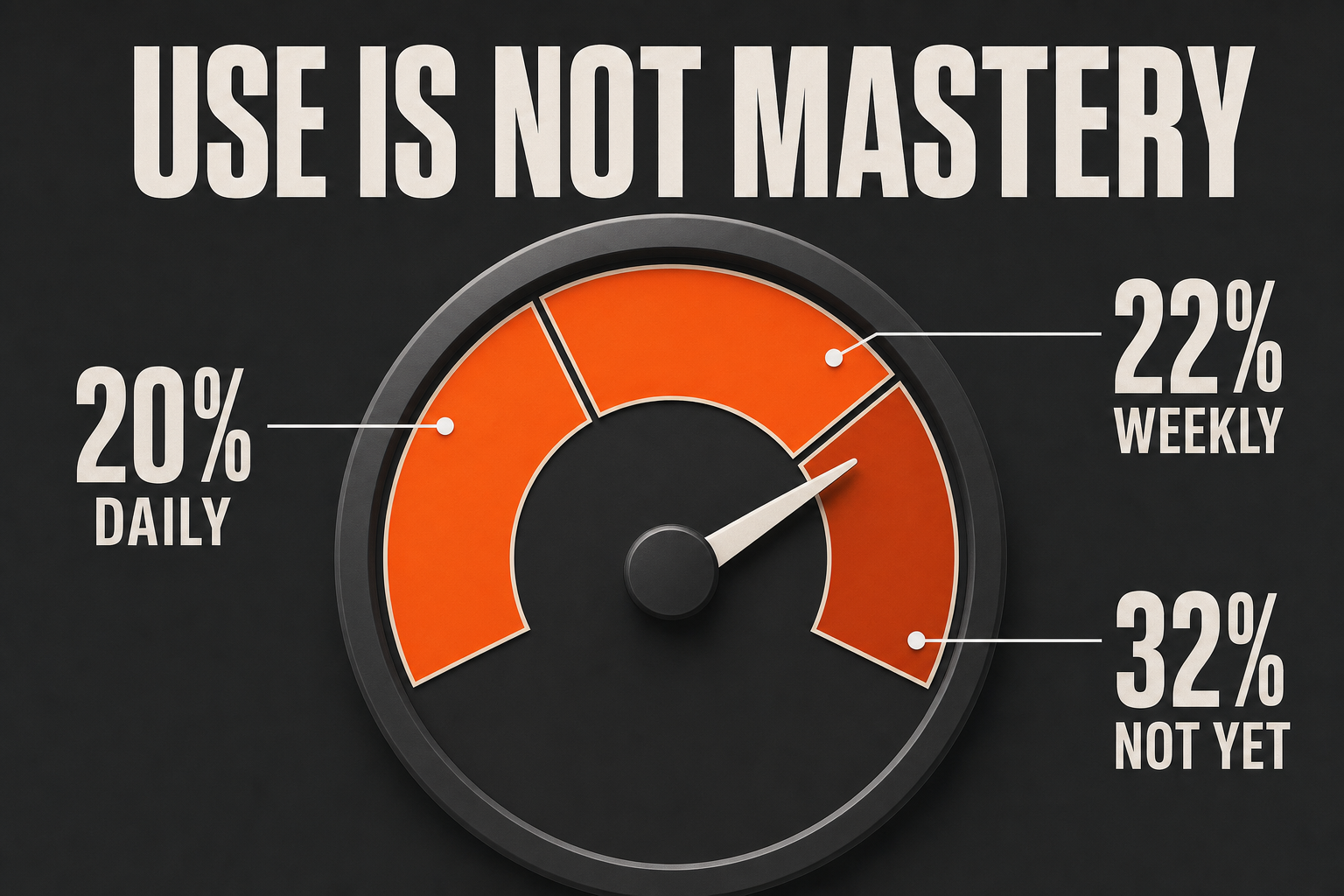
- NAR's 2025 technology survey found that 20% of respondents used AI daily, 22% used it weekly, and 32% had not tried it, which points to a market with meaningful use and plenty of room to improve
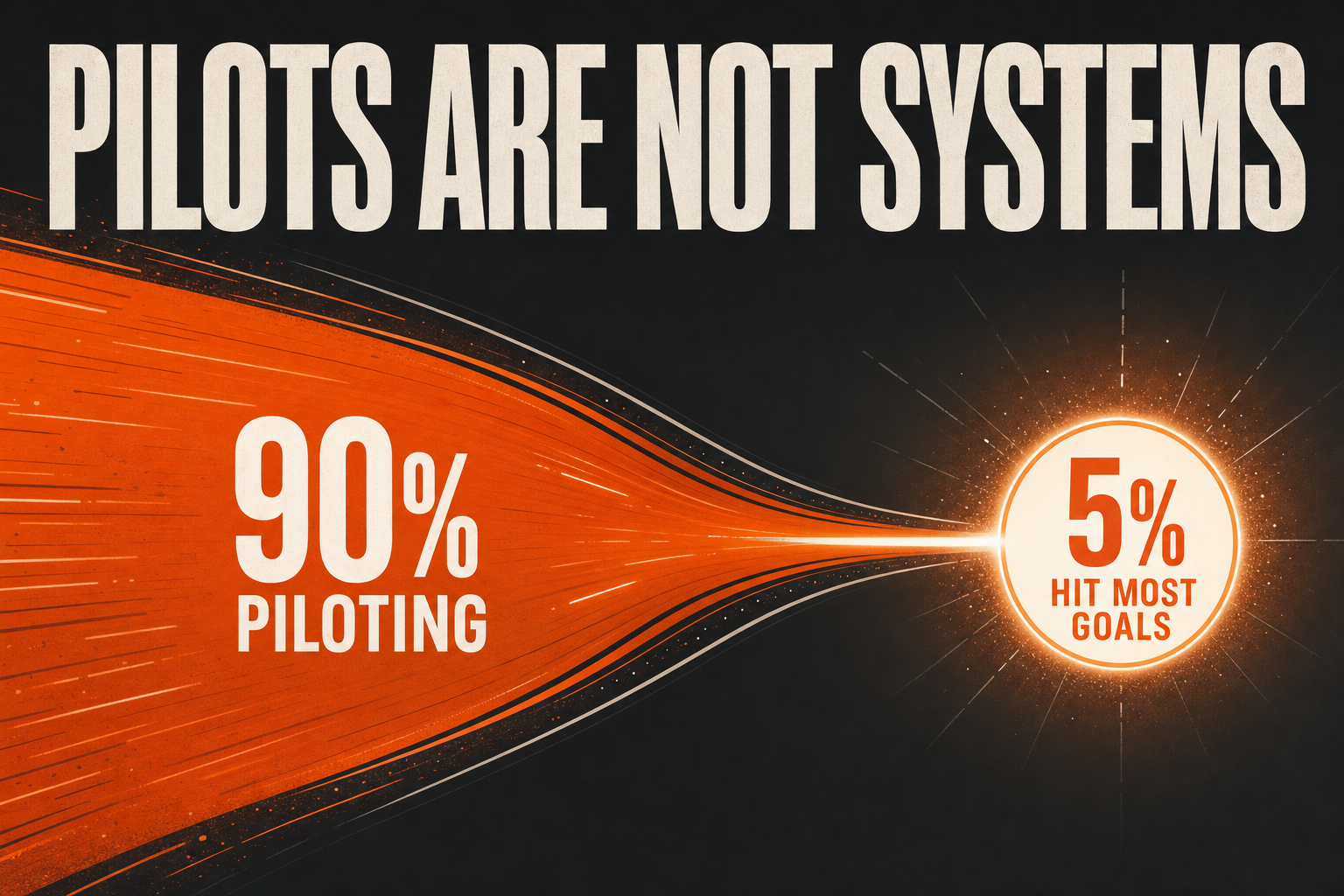
- JLL found that 90% of surveyed real estate organizations were piloting AI projects, but only 5% had achieved most of their program goals
- The practical advantage comes from turning one repeated task into a measured, reviewable workflow, not from collecting more tools or copying more prompts
AI for real estate agents can feel much farther along than it really is. Scroll through social media and you will see autonomous agents, instant marketing systems, AI-built websites, automated lead follow-up, and businesses that appear to run themselves. That feed creates a distorted benchmark. It compares your daily operation with the most polished demonstrations produced by the loudest and most technical people online.
The broader data shows a more useful picture. AI adoption is real and growing, but occasional use is not the same as a dependable operating system. Many professionals have tested a chatbot. Far fewer have connected approved sources, written decision rules, built human review into the workflow, measured the result, and maintained the system long enough to trust it.
That gap is good news. You do not need to catch up with an imaginary business that automated everything overnight. You need to pick one repetitive problem, create one safe workflow, and make it work consistently. A small system that saves thirty verified minutes every weekday is more valuable than twenty impressive demos that never enter production.
What Current AI Adoption Data Actually Says
The best place to start is the distinction between access, use, and operational maturity. Those three ideas are often blended into one headline, even though they measure different things.
Consumer spending offers one useful baseline. In its April 2026 Consumer Health Check, PNC reported that the share of households in its data paying for a generative AI subscription had reached about 2% near the start of 2026. That measure does not count free use, employer-paid access, or every possible AI product. It does show that paying for a consumer AI subscription was still far from universal.
In an April 2026 analysis, the Federal Reserve examined three public surveys of AI adoption. The business survey data showed that about 18% of firms had adopted AI by the end of 2025. A separate population survey found that work-related generative AI use stood at about 41% of the workforce in November 2025. Another survey of senior business leaders produced a much higher employment-weighted estimate because it asked whether a person's employer used AI, not whether every employee used it deeply.
Those numbers are not contradictory. They answer different questions. A company can report using AI because one department has a tool. An employee can report work use after asking a chatbot to summarize a document. Neither response proves that the organization has rebuilt a workflow around AI or achieved a measurable business result.
The Federal Reserve's central lesson is more important than any single percentage: adoption estimates vary according to the population being measured, the wording of the question, and the level of use required to count. When someone claims that almost every business has adopted AI, ask what adoption meant in that survey.
Real Estate AI Use Is Meaningful but Uneven
The real estate profession has already moved beyond pure curiosity. The 2025 REALTORS Technology Survey collected 1,241 usable responses from active NAR members. NAR reported that 20% used AI daily for business and another 22% used it weekly. At the same time, 32% said they had not actively tried it for their business.
That is a substantial user base, but it is not universal fluency. Daily use might mean drafting social copy, editing an email, brainstorming a video hook, or summarizing notes. Those are valid applications. They can save time and improve a first draft. They do not necessarily indicate that the user has a repeatable process, source controls, quality checks, or an audit trail.
NAR also reported that AI and generative AI were the most-used category among the emerging technologies listed in the survey. ChatGPT was the most common AI tool, followed by Gemini and Copilot. The pattern suggests that agents are exploring accessible general-purpose products before they invest in complex custom systems.
A smaller February 2026 survey from Realtors Property Resource adds another angle. Among 225 surveyed NAR members, 92% said they were using AI or planning to use it, 71% named time savings as the top value, and 63% named output accuracy as the top concern. Because the sample was limited to that survey group, it should not be treated as a census of the entire profession. It still highlights the practical tension agents are experiencing: the tools are useful, but trust and verification remain unresolved.
Why an AI Pilot Is Not an AI System
Pilots create excitement because they show what might be possible. Systems create value because they produce a dependable result under ordinary conditions.
JLL's 2025 Global Real Estate Technology Survey focused on corporate real estate organizations, not independent residential agents, so the populations are different. Still, its execution gap is instructive. JLL reported that roughly nine in ten surveyed real estate organizations were piloting AI projects while only 5% had achieved most of their program goals. Many organizations were pursuing several use cases at once, yet foundational issues such as data quality, change management, and talent limited results.
That same pattern appears on a smaller scale inside a real estate team. A prompt works well during a demonstration. Then a real file is missing a field. A source changes its layout. Two agents use different naming conventions. The generated output includes an unsupported claim. A workflow saves time for the creator but confuses everyone else. The pilot looked excellent because the example was controlled. The system struggles because normal business is messy.
A production workflow needs more than a clever instruction. It needs approved inputs, validation, clear ownership, an output standard, a human review point, error handling, and a way to stop the process. It also needs a baseline so you can tell whether it improved anything.
The Internet Comparison Is Useful, With Limits
The transition to online real estate listings offers a helpful comparison. Digital access changed how consumers found property information. It reduced the value of controlling basic inventory data, but it did not eliminate the need for pricing judgment, transaction management, negotiation, risk interpretation, and local market context.
AI can create a similar shift in the cost of producing information. Drafting, organizing, categorizing, summarizing, and transforming material can become faster. Basic output becomes abundant. The scarce value moves toward deciding what matters, verifying what is true, understanding the client, and taking responsibility for the recommendation.
The comparison should not be pushed too far. AI is not simply another publishing channel. It can synthesize information, operate tools, and take actions when it has access. That creates more leverage and more risk. A bad website draft is inconvenient. A workflow that sends an inaccurate client message, changes a record, or publishes a claim without review can create a real business problem.
The lesson is not that every agent must automate everything. The lesson is that technology lowers the cost of routine production, while human judgment becomes more visible. Agents who combine efficient systems with strong advice can improve service. Agents who use AI to generate more noise without verification may damage trust faster.
What AI Can Reliably Help With Today
The safest opportunities usually begin with internal preparation. They produce something a person can inspect before it affects a client, account, or public page.
Useful examples include:
- Turning meeting notes into a structured task draft for human review.
- Comparing a draft against a written checklist and flagging missing sections.
- Summarizing approved research into a concise internal brief with source links.
- Converting one verified fact set into several draft formats while preserving the source record.
- Organizing recurring questions into a content outline and identifying where evidence is missing.
- Preparing a quality-assurance report for a web page, presentation, or campaign before publication.
- Reconciling two exports and surfacing differences without changing the systems of record.
These workflows are useful because the input and output can be bounded. The agent can see exactly what material the AI received, what rule it followed, and what it produced. A person can compare the result with the standard before the next step.
Our Automation Scout skill walkthrough uses this principle. It starts with repeated work, traces the reason that work exists, compares several candidates, and builds the smallest complete workflow. The goal is not maximum automation. The goal is a reliable first improvement.
What Should Stay Human
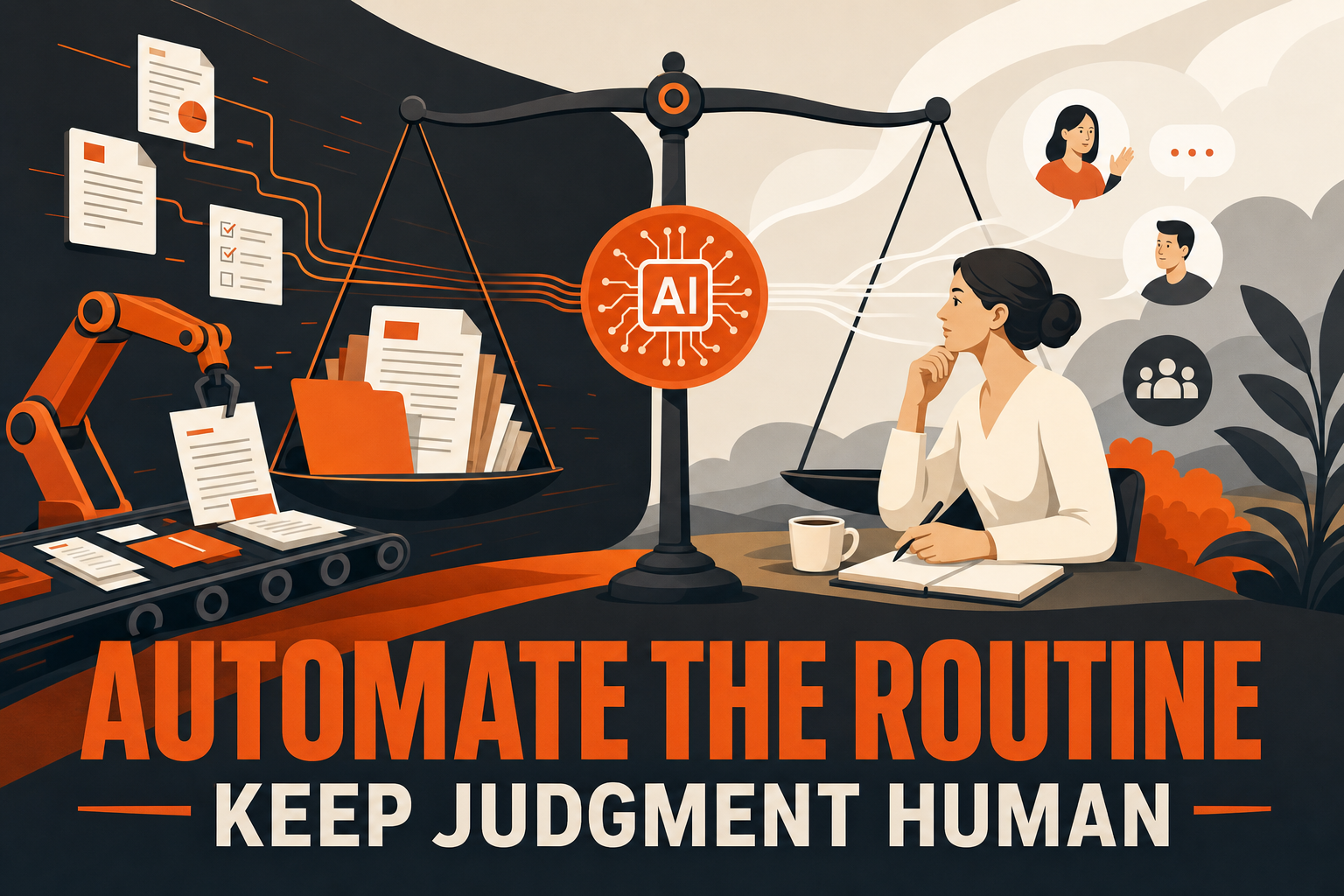
AI should not be the unreviewed decision-maker for high-stakes client advice, pricing strategy, legal interpretation, fair housing compliance, negotiation, confidential disclosures, or relationship-sensitive communication. It can help prepare information, but the licensed professional remains responsible for the service.
That boundary is not a weakness. It is the business model. Clients are not paying only for text production. They are paying for judgment under uncertainty, accountability, communication, and the ability to navigate competing priorities.
Consider a pricing conversation. AI can organize verified property facts, calculate transparent comparisons from approved data, create a draft chart, and flag inconsistencies. The agent still decides which evidence deserves weight, how condition affects interpretation, what the current competition means, and how to explain the tradeoffs without manufacturing certainty.
The same principle applies to client messages. AI can prepare a draft based on the approved record. The agent should review tone, facts, privacy, and context before sending. A technically correct message can still be wrong for the moment.
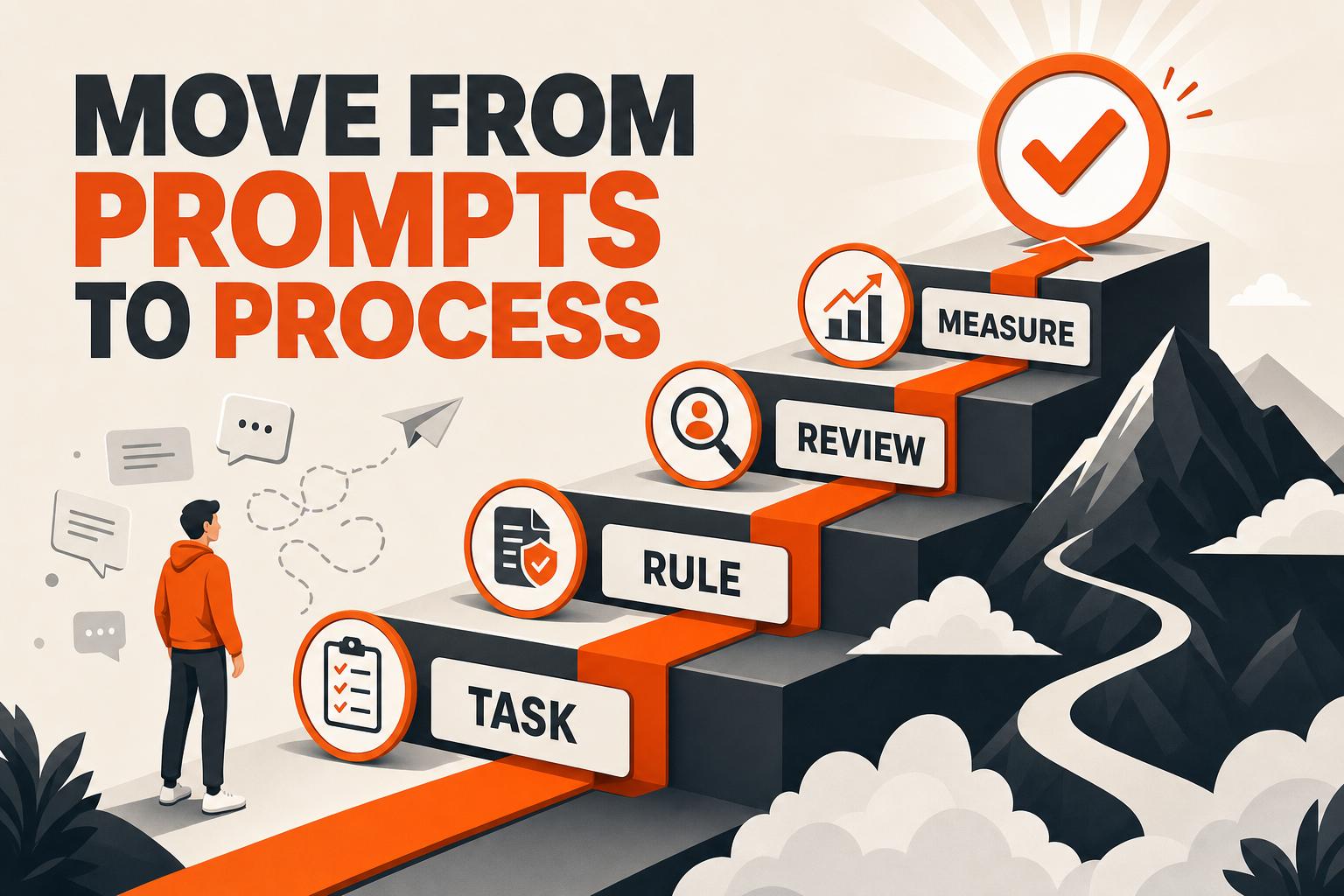
Move From Prompts to Process
Prompts matter, but they are only one layer of a dependable workflow. A good process answers four questions:
- Task: What repeated outcome are we trying to produce?
- Rule: What sources, constraints, and decision logic govern the work?
- Review: Who checks the result, and what must they verify?
- Measure: How will we know whether the workflow saved time, reduced errors, or improved consistency?
Start with one task that happens at least weekly and produces a reviewable output. Avoid beginning with outbound messaging, record deletion, payment, or anything that could materially affect a client without approval.
Document the current process before changing it. Record how often it occurs, how long it takes, who touches it, where mistakes happen, and what a good final result looks like. Then build a version that handles only the stable middle of the process. Keep exceptions visible instead of forcing the AI to guess.
For a practical example of this approach, our listing presentation automation case study separates source gathering, comp rules, presentation assembly, and final agent review. The system prepares. The professional approves.
A Seven-Day AI Workflow Sprint
You can build a meaningful advantage in one week without buying a large software stack.
Day 1: Choose One Repeated Task
Pick work that occurs often, follows a recognizable pattern, and ends in a draft or internal decision aid. Good candidates include report preparation, content research, checklist review, document organization, or weekly briefing assembly.
Day 2: Capture Five Real Examples
Collect representative examples, including at least one difficult case. Remove private information that is not needed. Identify the parts that remain consistent and the parts that require judgment.
Day 3: Write the Rules
List approved sources, required fields, prohibited claims, output format, and stop conditions. If the source is missing or contradictory, the workflow should flag the issue rather than invent an answer.
Day 4: Build a Draft-Only Version
Create the narrowest version that reads approved inputs and produces a reviewable draft. Do not add sending, publishing, or record changes. Keep the first version reversible.
Day 5: Test Normal and Bad Inputs
Run complete examples, incomplete examples, duplicates, unusual formatting, and conflicting facts. Record where the workflow fails. Fix the biggest objective defect once.
Day 6: Compare With the Manual Standard
Measure time, completeness, factual accuracy, formatting, and review effort. If the draft saves production time but doubles review time, the workflow has not yet created the expected value.
Day 7: Adopt, Revise, or Stop
Decide based on evidence. A stopped pilot is not a failure if it reveals that the source data is unstable or the process lacks a clear owner. Document the lesson and choose the next candidate.
Measure Results Instead of Chasing Demos
The cleanest scoreboard includes a small number of observable metrics:
- Minutes spent per completed output
- Percentage of outputs passing review without factual correction
- Number of missing-input exceptions
- Time required for human review
- Frequency of workflow failure or manual recovery
- Number of downstream steps removed
Track the baseline before the AI version runs. Then compare the same sample size after the workflow is stable. Avoid inflated claims about hours saved unless the measurement supports them.
Capacity is also a valid result. A workflow may not reduce payroll expense, but it can let the same team prepare a better brief, respond with stronger context, or publish a more thoroughly checked article. Name the outcome accurately.
The nine AI operating cycles framework expands this idea across content, research, SEO, and operational quality control. Each cycle has a signal, a rule, an output, and a verification step. The common principle is consistency, not spectacle.
Guardrails That Make AI More Useful
Good controls make an AI workflow easier to trust and easier to improve.
Use least privilege. Give the workflow access only to the sources it needs. Read-only access is the right default for discovery and drafting.
Separate preparation from action. Drafting a message and sending a message are different permissions. Preparing a page and publishing it are different permissions. Treat each external action as its own approval boundary.
Keep a source trail. Store the source links, timestamps, and assumptions needed to reproduce the result. A polished answer without traceable evidence is hard to review.
Protect confidential information. Minimize personal data, credentials, financial information, private notes, and access instructions. Do not include sensitive material simply because it is available.
Define a stop control. A scheduled job, automation, or connected agent needs a practical way to disable it. The person responsible should know where that control lives.
Review for compliance. AI-generated real estate content must describe property and market facts without targeting protected classes. Marketing claims, school information, statistics, and transaction details require verification before publication.
You Are Not Competing With the Loudest Demo
The opportunity is not gone. The data suggests a market in transition: broad experimentation, meaningful routine use, and a much smaller share of organizations that have turned pilots into measured systems.
Your next advantage is probably not a new model. It is a better operating procedure around a task your business already performs. Choose the task, define the standard, build a draft-only version, measure it, and keep human judgment at the point of consequence.
That is how AI becomes useful. It stops being a performance and becomes part of a reliable business.
Follow AgentAIBrief on Instagram for practical AI workflows, or subscribe to AgentAIBrief for implementation guides built for real estate professionals.
Frequently Asked Questions About AI for Real Estate Agents
Are most real estate agents already using AI?
Use is meaningful but uneven. NAR's 2025 technology survey found that 20% of respondents used AI daily, 22% used it weekly, and 32% had not tried it. Using a chatbot is also different from running a dependable business workflow.
What is the best first AI workflow for a real estate professional?
Start with a repeated internal task that ends in a reviewable draft, such as research summarization, checklist review, document organization, or report preparation. Avoid autonomous external actions for the first version.
How is an AI pilot different from an AI system?
A pilot demonstrates a possibility with controlled examples. A system has approved inputs, validation, written rules, human review, error handling, ownership, measurement, and a practical stop control.
Which real estate tasks should remain under human control?
Pricing judgment, negotiation, legal interpretation, fair housing compliance, confidential disclosures, client advice, and relationship-sensitive communication should remain under accountable human control.
How should an agent measure whether AI is helping?
Compare the AI workflow with a documented baseline. Measure production time, review time, factual corrections, missing-input exceptions, failure frequency, and whether the output passes the existing quality standard.